
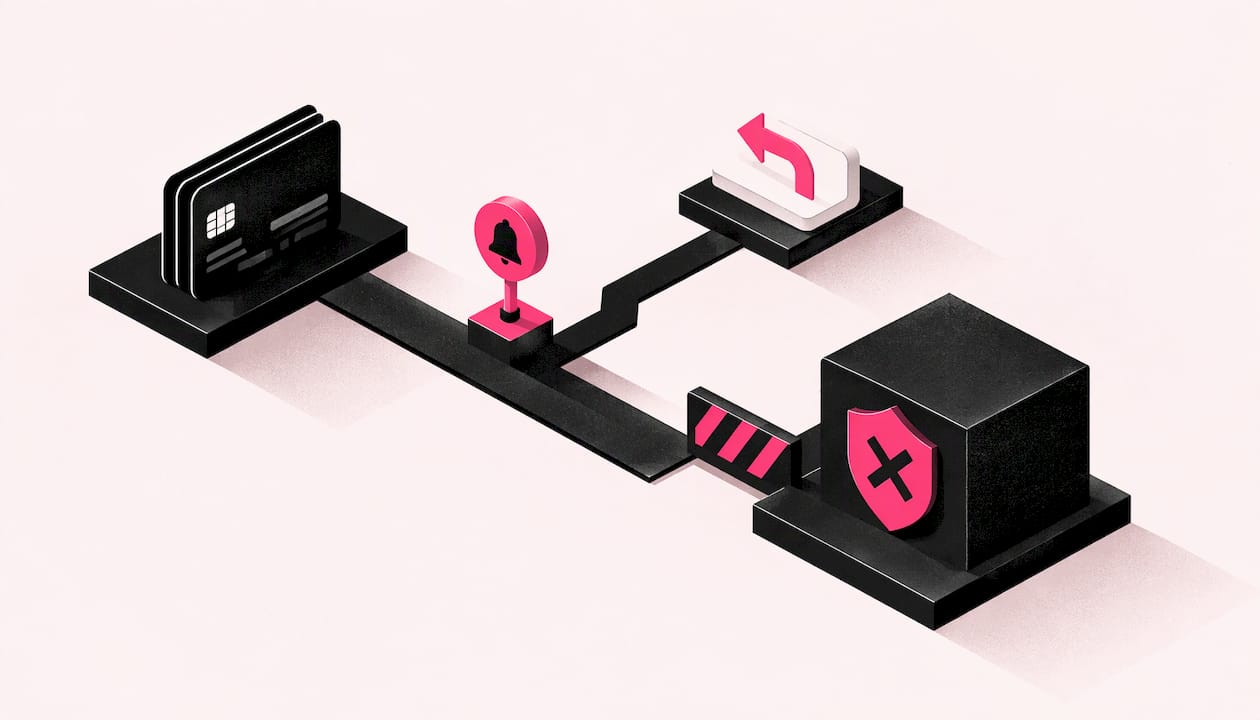
A chargeback alert is an early warning that a cardholder has disputed a charge with their bank, sent to you before the dispute becomes a formal chargeback. If you refund the order inside the alert window, usually 24 to 72 hours, the dispute can be stopped before it is filed. That saves you the chargeback fee and the staff time, and it keeps the dispute out of your chargeback count.
This guide covers who sends alerts, what is in them, how fast you need to act, what the economics look like, and the cases where an alert will not save you. It is written for finance and payments leads at US companies with real card volume, where a few points of dispute rate turn into serious money.
TL;DR
- Alerts come from two networks: Ethoca (Mastercard) and Verifi (Visa). They reach you before a dispute turns into a chargeback.
- The window is short. Ethoca's stated goal is a refund or stopped settlement within 24 hours, and Verifi's CDRN allows up to 72 hours.
- Every deflected dispute is still a refunded order, so judge an alert program by cost per dispute stopped, not by the per-alert fee alone.
- Alerts do not cover every issuer, card brand or dispute type, so they work best alongside clear descriptors, fast refunds and a processor that gives you full fee visibility.
- Alerts feed one part of the picture. The rest is what your processing contract costs and how your processor handles disputes and holds.
Table of Contents
- What a chargeback alert is, and how it differs from a chargeback
- Who sends alerts: Ethoca and Verifi
- What is in an alert and how it reaches you
- How much time you have to respond
- What alerts cost, and how to judge the economics
- Alerts and Visa's monitoring program
- What alerts cannot do
- Making alerts work: a practical setup
- Perspective
- See what your dispute and processing costs really are
- FAQ
- Sources
What a chargeback alert is, and how it differs from a chargeback
A chargeback alert is a notification, not a ruling. The cardholder has told their bank something is wrong with a charge. The bank, if it participates in a prevention network, passes that signal to you while the case can still be settled with a refund.
A chargeback is what happens next if nobody acts. Funds are pulled back, the case is recorded against you, and a fee applies. At that point a refund no longer avoids the chargeback. You can read our short definition of a chargeback for the formal terms.
The practical difference is timing and options:
| Chargeback alert | Chargeback notification | |
|---|---|---|
| When it arrives | Before the dispute is filed | After funds have been pulled back |
| What you can do | Refund, stop shipment or settlement | Submit evidence (representment) or accept the loss |
| Counts as a chargeback | Not if resolved in time | Yes |
Kount's support documentation says prevention alerts do not affect a merchant's chargeback count or ratio. It adds that if you neither refund nor respond by the deadline, the case will likely advance to a chargeback.
Who sends alerts: Ethoca and Verifi
There are two networks behind nearly every alert program in the US.
Ethoca is Mastercard's. Ethoca's FAQ describes its alerts as notifications about specific transactions, covering confirmed fraud and customer disputes, that may become chargebacks unless the merchant acts.
Verifi is Visa's. It runs two products you will see named in processor dashboards:
- CDRN (Cardholder Dispute Resolution Network): an alert you answer by crediting the cardholder.
- RDR (Rapid Dispute Resolution): a rules-based option where you set criteria in advance and eligible disputes are refunded automatically.
Most merchants do not buy these directly. They get them through their processor or a third-party service, and which products you can reach depends on that setup. Ask whoever runs your processing which networks you are enrolled in, and whether enrollment covers every merchant account and descriptor you use.
What is in an alert and how it reaches you
Ethoca alerts are delivered through a portal, where you get an email and log in, or through a web service API. According to Ethoca, each alert includes the card number, authorization date and time, transaction amount and merchant descriptor.
That is thin. There is no customer story and no reason code you can rely on, so matching the alert to your own order is the first job. The match relies on the amount, the date, the billing descriptor and the card BIN. Of these, the descriptor is what breaks most often in practice, and it is the one you control. If your statement descriptor does not look like your brand name, customers fail to recognize charges and dispute them. The same descriptor also makes alert matching harder.
Where the alert is delivered matters as much as what it says. If the alert lands in an inbox that a person checks twice a day, you will miss windows. Teams that handle volume route alerts to the order system by API, so a refund can fire without anyone logging into a second tool.
How much time you have to respond
The window depends on the network.
- Ethoca: the aim is to refund or stop settlement as soon as possible, within 24 hours, and notify the issuer through the portal or API.
- Verifi CDRN: Verifi's published guidance gives merchants 72 hours to start a cardholder credit before a chargeback is filed.
Treat 24 hours as the working number for everything. Kount's guidance on alerts that still turn into chargebacks lists the common causes: refunding too slowly (typically within 24 hours), not responding, refunding only part of the amount, or refunding under a different merchant account ID. Each of those is a process problem you can fix.
A workable response routine looks like this:
- Send alerts into your order system by API, not into a shared inbox.
- Match the alert to the order using amount, date, descriptor and BIN.
- Refund the full amount from the same merchant account that took the payment.
- Stop any shipment or fulfillment that has not left.
- Confirm back to the network that you acted, through the portal or API.
- Review exceptions by hand, such as high-value orders, repeat disputers and anything that looks like genuine fraud you want to investigate.
Steps 1 to 5 can be rule-based. A human queue works during business hours and fails at night and on weekends, which is when much of the window passes.
What alerts cost, and how to judge the economics

Alert pricing is per alert, set by the vendor or your processor, and it varies by network and by how you buy. Get the current rate card in writing from whoever supplies yours, and ask whether there are setup fees, monthly minimums or volume tiers.
The per-alert fee is only one line, though. Three numbers decide whether alerts pay off for you:
- The cost of a chargeback. Javelin Strategy & Research reports that merchants spend $46 in external fees and $82 in internal expense per chargeback, $128 in total, before counting the lost goods. The scale of the problem is large: Javelin puts the 2025 figure for disputed and charged-back card transactions at $34 billion.
- The refund. Every deflected dispute is a full refund of the order. If your average order is $120, a $24 alert means $144 out the door for that sale, and the goods are usually gone. The saving is the chargeback fee, the labor, and the damage to your dispute ratio, not the order value.
- Your deflection rate. An alert only prevents a chargeback if you act inside the window. Say an alert costs $24. At a 90% deflection rate you spend about $26.67 per dispute stopped. At 50% you spend $48. Speed is what moves that number.
A simple check: take your monthly disputes, multiply by the share your networks actually cover, then by your deflection rate. Compare the alert fees plus refunded revenue with what the same disputes would cost at $128 each. Then add the effect on your ratio, which is where the larger risk sits.
Alerts and Visa's monitoring program
Dispute ratios matter because card networks watch them, and an excessive ratio brings fees, remediation and in the worst case loss of processing. For Visa, the relevant program is VAMP. Our entry on Visa VAMP explains how it works.
Two details from Visa's own VAMP fact sheet:
- The VAMP ratio excludes disputes resolved through pre-dispute solutions, depending on the timing of the data extract.
- From April 1, 2026, a US merchant is rated excessive at a ratio of 1.5 percent with at least 1,500 fraud reports and disputes in a month.
One caution on fraud claims. A refund through an alert can keep the dispute out of Visa's count, but the fraud report the issuer filed may still count toward your ratio. So alerts help, but they do not make a fraud problem disappear. Fixing the source, through better authentication and clearer descriptors, remains necessary.
For a wider view of how disputes drive cost at volume, see our page on chargeback and dispute costs at scale.
What alerts cannot do
Alerts are valuable, and they are also bounded. Knowing the bounds lets you plan around them.
Not every bank takes part. Participation in a prevention network is optional for issuers. If a bank is not in Ethoca or Verifi, the dispute advances to a chargeback and you never get an alert. Some issuers have chosen not to join or lack the data capability.
A refund is not an ironclad guarantee. BlueSnap's documentation notes that alerts do not guarantee a chargeback will be avoided. It puts the success rate of alerts preventing a chargeback at about 90%, depending on issuer participation and dispute type.
Leakage happens. A transaction can receive both an alert and a chargeback. This usually stems from issuer action, and the alert vendors cannot control it. Slow, partial or mismatched refunds make it more likely.
Some disputes sit outside the system. A dispute filed straight with the bank, outside participating coverage, can still become a chargeback. Tokenized wallet payments can be harder to match to the original sale.
Coverage varies by brand. Coverage for the major US card brands is not uniform, and it also depends on how your processing is set up. Ask your provider for coverage by card brand, not a single headline number.
Alerts are the early stage only. Disputes that do become chargebacks still need an evidence process, and a clear descriptor and refund policy reduce them upstream.
Making alerts work: a practical setup
For a US company with seven or eight figures in monthly card volume, the setup that tends to hold up looks like this.
Enroll everywhere you process. Cover each merchant account, descriptor and brand you use. A gap in enrollment is a gap in coverage, and descriptors you forgot about are the usual culprit.
Fix the descriptor. Make the statement descriptor recognizable, include a support phone or URL where your processor allows it, and keep it consistent across products. Customers who recognize a charge do not dispute it.
Automate the refund path. Write rules for the common case: full-amount alert, order not yet shipped or low risk, refund immediately. Send exceptions to a person. Time-to-refund is the lever on your deflection rate.
Keep subscriptions clean. For recurring revenue, a good share of disputes come from failed expectations: a renewal the customer forgot, or an expired card that was retried. Cancel the subscription when you refund an alerted charge, so the customer is not charged again next month and disputing again. A card account updater and sensible retry logic reduce the friction that leads to angry customers. Our piece on why good payments get declined covers the controls you have.

Measure monthly. Track alerts received, alerts refunded in time, chargebacks that leaked, and cost per dispute stopped. If deflection is under target, the usual fix is routing speed, not a different vendor.
Perspective
We look at chargeback alerts from the processing side, and the first thing we see on most statements is that dispute cost is rarely shown in one place. Fees for receiving a dispute, per-alert charges, refunds on flat-rate deals and the margin the processor keeps all sit in different lines, or inside a blended rate.
That matters for a company at $10M or more in annual card volume. If you cannot see what each dispute-related fee is and who keeps it, you cannot tell whether your alert program is cheap or expensive. That is why our free review of your processing statements breaks out interchange, network fees, processor margin, international and dispute fees, and puts a dollar figure on interchange-plus pricing at your volume.
Our approach to disputes is prevention first. We show what tends to trigger account reviews before a launch, a large deal or a volume spike, so you are not finding out after the fact. If funds are ever held, your dedicated contact works on it with you until it is resolved, rather than sending you to a shared queue.
Alerts are a good tool. A transparent processing contract and a person who knows your business make them work better.
the author
See what your dispute and processing costs really are
If you process $10M or more a year on Stripe, we can start with a free review of your statements. We calculate your effective rate, show where each fee goes, including dispute fees, and give you a dollar figure for what interchange-plus pricing would cost at your volume. There is no obligation.

If the numbers make sense, we plan the switch with you: card data migration under PCI rules, subscriptions that keep running, and minimal engineering effort. You can read how that works on our Stripe alternative page. For a wider look at lowering what you pay, see our guide to reducing credit card processing fees at scale.
FAQ
Do chargeback alerts count as chargebacks?
No, not when you resolve them in time. Kount's guidance says prevention alerts do not affect your chargeback count or ratio. If you miss the deadline, the case will likely advance to a formal chargeback, and then it counts.
How fast do I need to respond to an alert?
Plan for 24 hours. Ethoca's aim is a refund or stopped settlement within that time, and Verifi's CDRN allows up to 72 hours. Automating refunds by rule is the dependable way to hit the window outside business hours.
Why did I get a chargeback and not an alert?
Usually the issuing bank does not participate in Ethoca or Verifi, or the dispute was filed outside covered channels. It can also be a leaked alert, where a slow, partial or mismatched refund let the case proceed. Check descriptor matching and refund speed first.
Are chargeback alerts worth the cost?
Often, if you act inside the window. Javelin reports an average of $128 in total handling cost per chargeback, which usually exceeds the per-alert fee. Remember the refunded order value too, and calculate your cost per dispute stopped from your own deflection rate.
Sources
- Ethoca FAQ: How to fight chargebacks
- Kount: Retrieval request, prevention alert and chargeback
- Kount: Why did my alert turn into a chargeback
- Kount: Why did I receive a chargeback and not an alert
- BlueSnap: Chargeback FAQs
- Javelin Strategy & Research: Chargebacks, The Case for Coordination
- Visa Acquirer Monitoring Program fact sheet